Table of contents
The project charter is the single document that prevents that drift. Yet across industry, charters are rushed, built from templates, or ignored entirely.
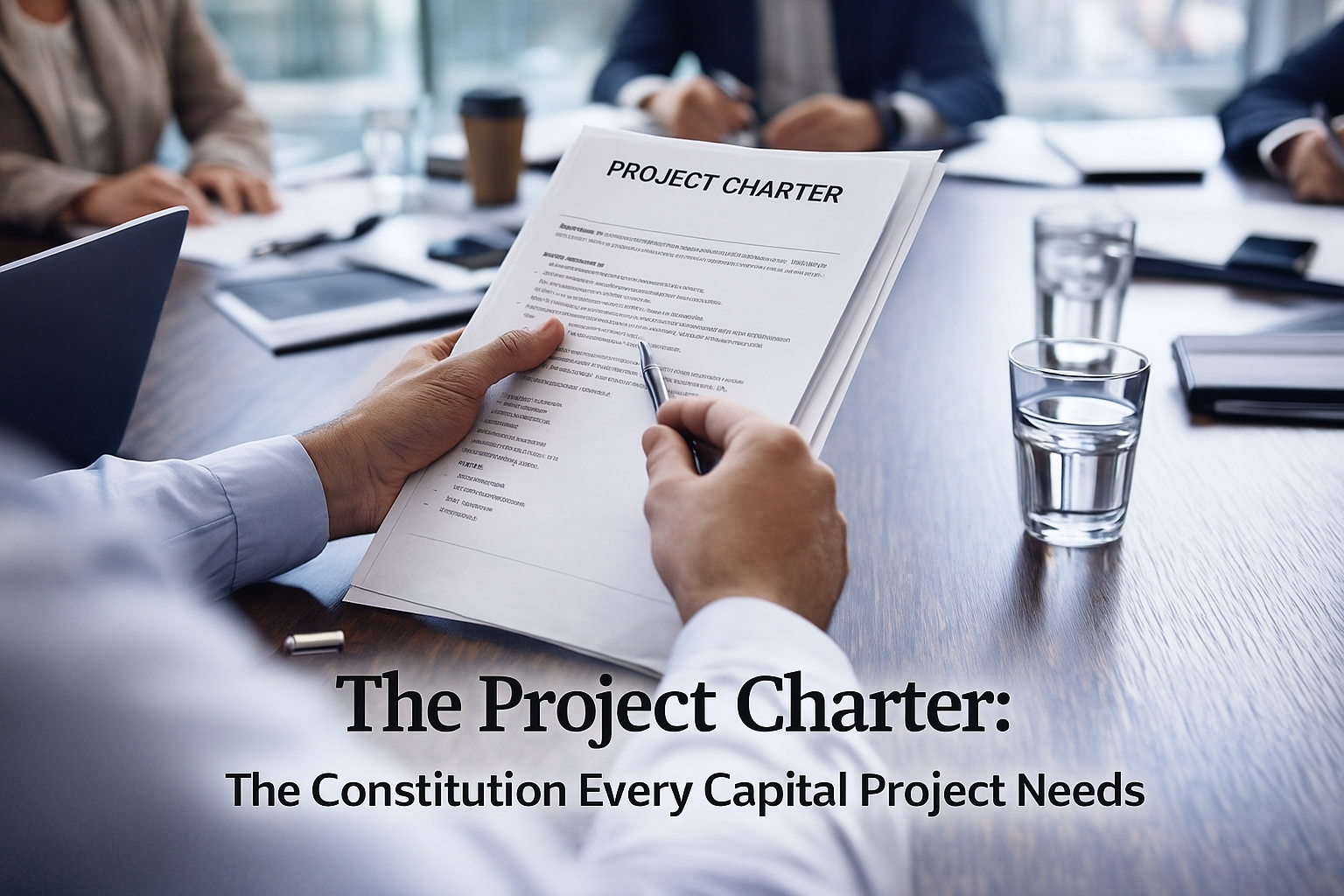
At BPMP, we treat the charter as the project’s constitution. It is the first and most important act of governance, alignment, and value protection. When done correctly, it becomes the anchor for FEL discipline, leadership behavior, and downstream decision quality. When done poorly, it becomes the silent root cause of cascading misalignment, scope battles, and late-stage chaos.
This article breaks down the role of the charter, what belongs in it, who should see it, and why owners must never delegate its creation.
Why the Charter Matters
A strong charter is not paperwork, it is leadership clarity. It sets direction, defines value, and protects the team from constant renegotiation.
The charter’s purpose aligns with BPMP’s Operating Framework:
- Define the business intent so the team understands why the project exists
- Establish success criteria so value is explicit and measurable
- Set scope boundaries so decisions don’t devolve into functional battles
- Document assumptions so risk can be tested rather than ignored
- Clarify governance so decisions are fast, legitimate, and unambiguous
- Set leadership expectations so behavior is aligned before work begins
- When these elements are missing, FEL discipline breaks down before it can start.
The Six Elements Every Charter Must Contain
BPMP has seen hundreds of projects across industries and one pattern is universal:
If even one of these elements is unclear, the project carries unnecessary risk from day one.
1. Business Intent
The most important section.
Why are we doing this? What value are we pursuing?
Many teams, especially junior engineers, work for years without ever hearing the business purpose. That gap creates friction, rework, and inconsistent decisions.
2. Success Criteria
Avoid generic statements like “on time and on budget.”
Success must be specific and tied to asset performance and business value:
- safe startup
- rapid on-spec production
- achieving nameplate capacity
- minimizing unplanned events
If leadership doesn’t define success, each function will invent its own, and conflict is guaranteed.
3. Scope Boundaries
Three buckets:
- What’s included
- What’s excluded
- What is undecided
“Undecided” is not a weakness, it is honesty. Documenting uncertainty prevents silent assumptions and wasted engineering cycles.
4. Assumptions
Every project rests on assumptions: permits, utilities, tie-ins, technology maturity, market conditions.
Unstated assumptions mutate into unmanaged risk.
Stated assumptions can be tested, challenged, and validated.
5. Governance & Decision Rights
One of the most neglected elements, and the fastest source of political tension.
A strong charter answers:
- Who owns what decisions?
- Who approves?
- Who has authority during FEL?
- How are conflicts escalated?
Clear governance accelerates work. Ambiguous governance paralyzes it.
6. Leadership Expectations
This sets the behavioral contract for sponsors and project leaders:
- clarity
- transparency
- accountability
- cross-functional collaboration
Without explicit expectations, leaders default to personal style, rarely aligned.
Who Should See the Charter? (Hint: Everyone)
Most organizations treat the charter as a senior-leadership formality. That is a mistake.
Visibility should include:
- sponsors and executives
- engineering
- operations
- HS&E
- finance
- supply chain
- project controls
- construction partners (selectively)
- engineering contractors (fully)
You cannot expect alignment around a document the team has never seen.
BPMP recommends using the charter as part of onboarding, not just a handout, but a facilitated discussion that aligns intent, boundaries, and leadership expectations.
Should Contractors See the Charter? Yes.
Engineering contractors shape early technical decisions that influence cost, schedule, operability, and risk.
They cannot make sound tradeoffs if they do not know:
- the business intent
- the success criteria
- the scope limits
- the assumptions
- the governance model
But there is one non-negotiable rule:
Owners must never delegate charter creation.
If owners fail to define intent, contractors will fill the void with their defaults, which rarely align with the owner’s value drivers.
Construction contractors also need visibility, though with more selectivity. Understanding purpose, constraints, tie-ins, site realities, and sequencing drivers allows them to shape realistic constructability and schedule plans.
How to Build a Charter the Right Way
A proper charter is simple to read but not simple to create. It requires:
- a structured workshop
- the right leaders in the room
- facilitation that surfaces misalignment early
- challenge of assumptions
- intentional iteration
A neutral facilitator is critical. Without one, sessions devolve into positional arguments or silos defending their preferences.
This investment in structured clarity prevents years of rework and conflict.
What Happens When You Rush or Skip the Charter
Projects don’t fail mysteriously, they fail predictably.
Skipping the charter leads to:
- no alignment
- no basis for decisions
- inconsistent success definitions
- governance paralysis
Rushing the charter leads to:
- scope battles and definition churn
- political schedules
- exploding change volume in FEL-3
- rework and lost credibility
- demoralized teams
- unresolved leadership conflicts
Most chaos attributed to “external shocks” is actually self-inflicted through weak early clarity.
Final Word: Clarity Is a Competitive Advantage
In capital projects, clarity outperforms speed.
The project charter is where that clarity begins.
A strong charter is not a formality, it is the first act of leadership.
It is the foundation that protects value, accelerates FEL maturity, and allows teams to operate with purpose instead of confusion.
When owners take this step seriously, everything downstream becomes faster, cleaner, and more predictable.